Electronic Musician and Modular Synth Maestro Richard Devine Pushes the Boundaries of Live Performance and Studio Recording with Solid State Logic SiXDevine achieves ‘brutally beautiful, polished sounds’ with his modular system, along with SSL SiX mixer, 500-series Bus Compressor and E Series EQ modulesAtlanta, GA, June 2020  Modular synthesist Richard Devine is a modern-day pioneer in the world of electronic music. As a musical artist, he has six albums under his belt and has headlined international tours; as a sound designer, he has created patches for legendary musical instrument brands such as Moog Music and Native Instruments; as a composer he has scored advertisements for Nike, Touchstone Pictures and others; and as a futurist and thought leader, he has coded his own applications in SuperCollider, a programming language for real-time audio synthesis. Recently, Solid State Logic has become an integral part of his creative workflow — both live and in the studio.
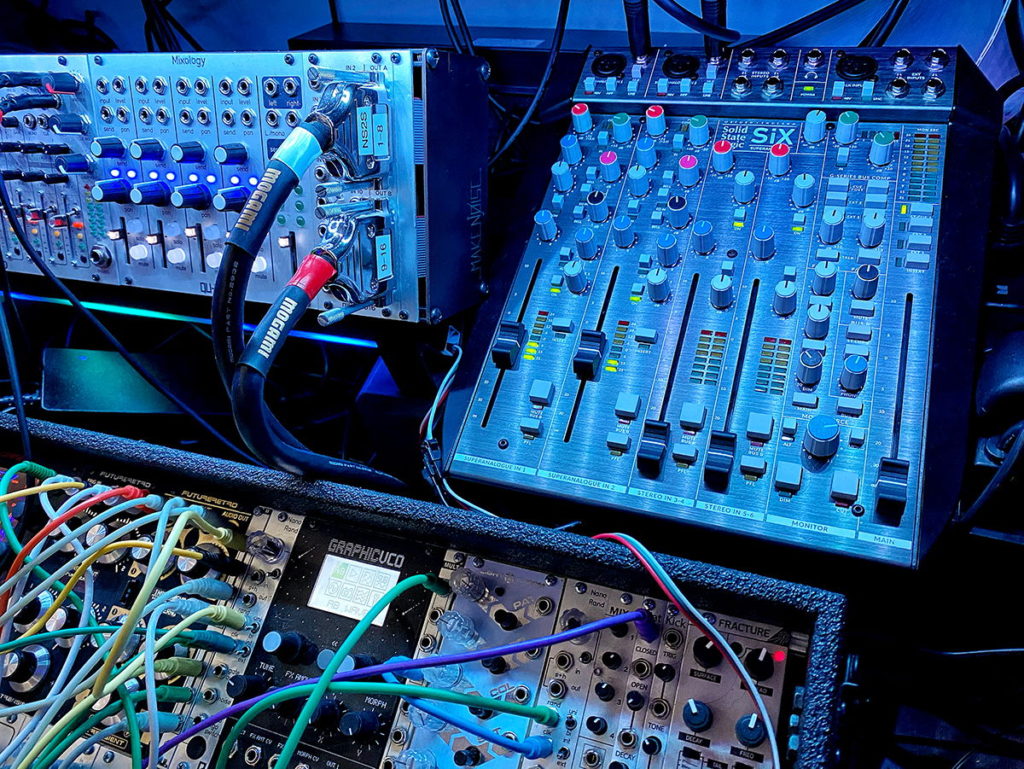
 “I was fascinated with SSL for a long time,” says Devine. “Down here in Atlanta, you go to any of the top studios and there will be SSL mixing desks. It is an industry standard and I wanted to understand why. So I invested in a few key pieces including SSL’s 500-Series format G Series Bus Compressor and a pair of E-Series (611) EQs. Once I ran my mix through the master bus, I thought, ‘Oh my God, this is the real deal.’ It just made such a huge difference.” Devine subsequently acquired a SSL SiX mixer, which features two SuperAnalogue™ recording channels equipped console grade mic pres, two-band EQ and channel dynamics, in addition to two stereo inputs, inserts and 100mm faders and a two knob version of the legendary SSL Bus Compressor. After trying SiX in the studio, he took it out on the road and never looked back: “I’m now using it for all my live shows,” he states. “The main thing that I noticed immediately is that you can feed the SiX a super-hot signal and it just eats it up — there is a massive amount of headroom. Now my entire modular rig hits the SiX as its last stop before I hit the PA.” Love at first patch

In the studio, Devine’s Eurorack-based modular system consists of several ‘floater’ cases he uses to help him navigate through the different parts of each composition, before ultimately going through the SSL SiX. “Generally, I like to start with rhythms and tempos with sequencers, and then I move to more tonal based modules using oscillators and envelopes. And then I have racks that are just effects. I link all these cases together so they share the same clock — between five and seven cases — and play the entire patch, working my way through each ‘movement’ in my composition.Devine used to compose directly in the DAW, but he says working directly in his modular system was more conducive to his creative output. “It felt natural and organic compared to how I was used to working in a DAW on a timeline. When you are working with the modular, the system is always running. You are deciding in real time when things are going to change, when things are going to get less complex or more subtle. This way of working is based on emotion and on what you are hearing and seeing. Working in the DAW you are getting a lot of visual feedback, but with modular, I feel like I am using my ears and responding to the music more.” SSL G Series compressor and E Series EQ: The dynamic duo

When multi-tracking, Devine will send up to 32 outputs from his system via nw2s I/O modules which are connected by four DB 25 snakes. These are then sent into a pair of 16 channel interfaces before hitting the DAW, whose primary function is as a ‘tape machine.’ Drums and sequences are often the foundational element in Devine’s compositions — these are all sub-mixed together before finding their way through a pair of 500-series format SSL E-Series (611) EQs: “I use the E Series EQs to shape the dynamics for all my drums. They impart an expensive hi-fi sound that I like — completely different from a 1073. They are good for snares and midrangey stuff that I want to poke through the mix a bit more. I also use them to reshape my kick drums and bring out the transients.”Along with the E Series EQ, Devine had been using his G Series Bus Compressor across the drum bus. More recently however, the G Series compressor has been promoted to handling final mix duties across the master bus: “I use it a lot for drum buss processing — particularly on kick and snare. But lately I’ve been using it as the final ‘polish’ of my master output, because it just does such a nice job. I prefer the SSL for ‘my sound’ over other compressors – I’ve done shoot outs with all of them and the SSL just works better for my music.” Devine describes the G Series compressor as imparting a ‘final polishing’ effect: “Everything I put through this compressor just has this very beautiful rounded weight to it, but is also very direct and forward. It is a brilliant design and I can see why countless hit records have used this compressor at the final end game.” Richard Devine and ‘Days of future patched’
Despite having achieved fame in the modular world as a futurist and thought leader, Devine considers himself a student: “I always tell people I am just a student in a class, constantly learning new things all the time, and I still feel that way today.” Devine’s most recent extra-curricular learnings include live coding, programming and AI: “The live coding thing is really interesting to be because there are no rules. You can create what I call these impossible scenarios that would be really difficult to do with a conventional DAW or Eurorack system. At the same time, I’ve been researching AI generative machine learning systems that develop and make sound. You tell the machine learning algorithm ‘Hey, these are my favorite eight patches,’ and it will analyze these and give you more than 1024 new variations based on the ones you picked. Then you can trajectory map over these regions and snapshot them.
It’s a great way to create new sounds to generate new content as a sound designer.”Summing up his experience with the SSL SiX, Devine says that the SiX has been one of the best investments he’s made in the last year. “It’s crazy how well engineered SSL’s equipment is, and the SiX is now my permanent live mixer. It has been a revelation for me.”

Waldorf announces Iridium 16 voice digital desktop synth

REMAGEN, GERMANY: having opened eyes and ears when introducing its forward-looking flagship Quantum Synthesizer keyboard to widespread critical acclaim in 2018, Waldorf Music is proud to introduce its Iridium Synthesizer ‘sibling’ — sharing futuristic functionality and advanced tonality and applying those traits with welcomed added extras to a compact desktop form factor living up to the high-quality synthesizer developer’s demanding design standards — as of June 12…

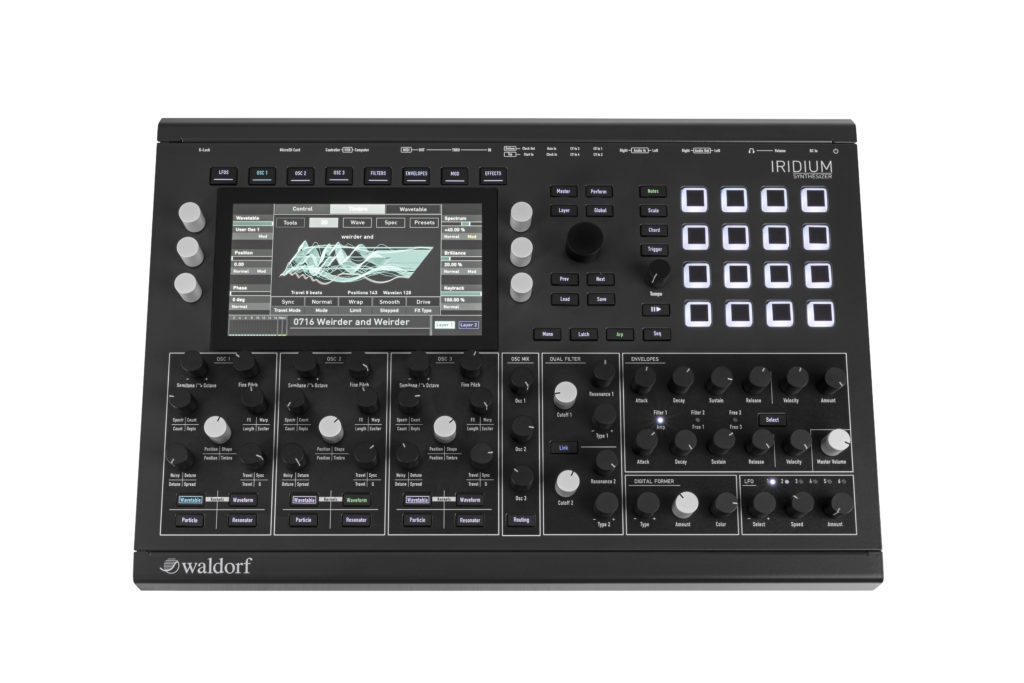
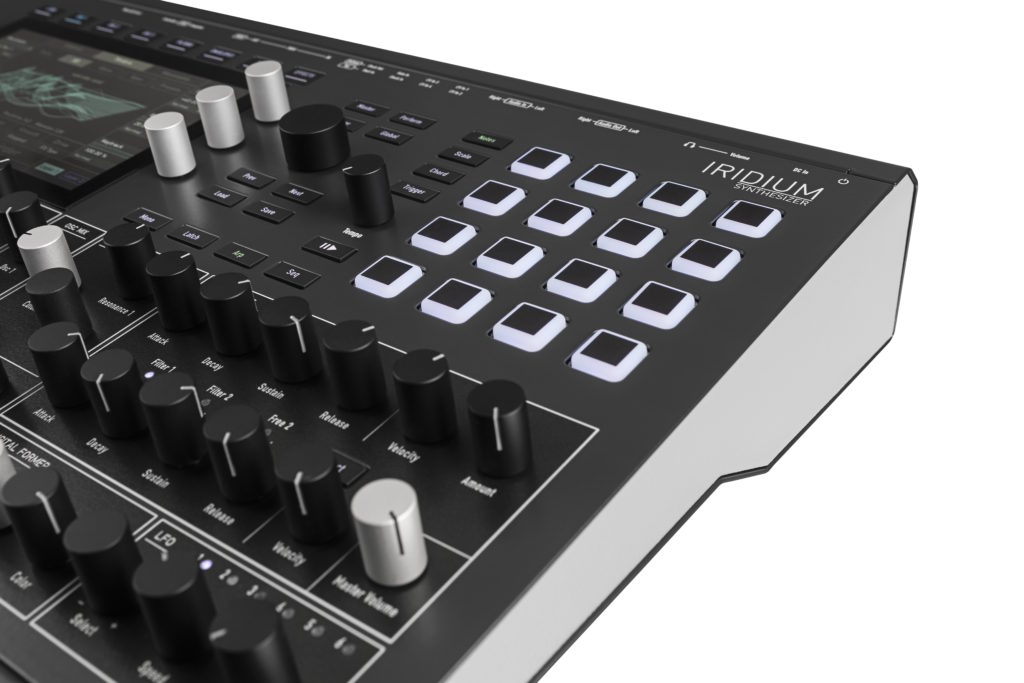
Following in the Quantum Synthesizer’s trailblazing footsteps, the Iridium Synthesizer features a generous high-resolution multitouch display working — with haptic help — in perfect harmony with an adroitly arranged control panel positioning all functions for speedy operation. Noticeably new to the demonstrably differentIridium Synthesizer is its integrated 4 x 4 pad matrix, used to call up sequences, chords, scales, and arpeggios. A quick glance under the hood, however, reveals that the Iridium Synthesizer still shares the same selectable sound generation processes per oscillator (OSC 1OSC 2, and OSC 3). As such, it can convincingly and comprehensively reproduce the sound spectra of the following five synthesis types: WavetableWaveformParticleResonator, and Kernels.
As a direct descendant of the legendary PPG Wave hybrid digital/analogue synthesizer series that made their mark throughout the Eighties by bringing the distinctive sound of wavetable synthesis to the musical masses, the well-known Waldorf Music marque is synonymous with top-tier wavetable sounds. Subsequently refining and expanding this sound generation process’ potential, the sound of Waldorf wavetable oscillators span subtlety to brutality — animated, digital, and diverse, yet easy to control. Classic wavetables from well-known wavetable synthesizers hailing from the PPG and Waldorf stables, spectral analysis, speech synthesis, wavetable generation from audio material, and more besides are all available to Iridium Synthesizer users when selecting Wavetable.
With early wavetable synthesizers, even, typical waveforms familiar from analogue synthesizers were always available at the end of a wavetable. Waveform selection on the Iridium Synthesizer goes far beyond this, though, by offering up to eight simultaneously selectable waveforms per oscillator, enabling infinitely dense, fat analogue-sounding tones, with detuned modes, tuneable noise, and hard sync.
2GB internal sample flash memory is available to the Iridium Synthesizer’s Particle oscillator, opening up exciting new possibilities of traditional stereo sampling with granular synthesis functionality — also available when processing a live input signal — for extensive manipulation of sample-based sounds. So the Iridium Synthesizer comes complete with 2GB sample content, while sample material can be reloaded or backed up by the user via USB drives or MicroSD Card connections.
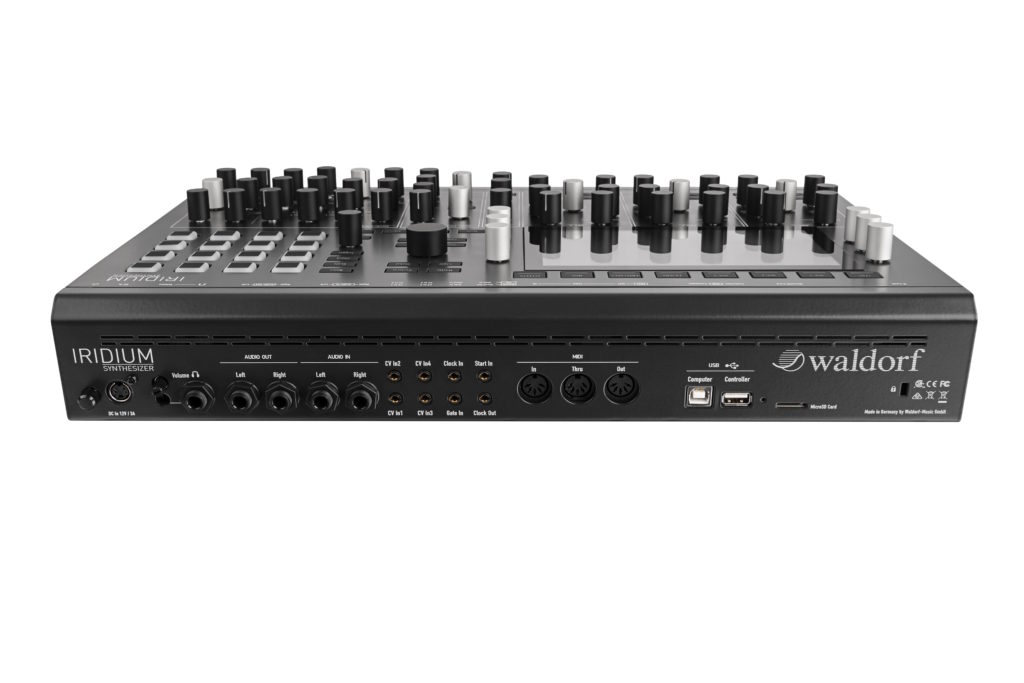
Creativity abounds further still when selecting the Resonator sound generation process to manipulate multi-samples from the internal sample flash memory or noise via an exciter and various modulate-able spectral parameters — perfect for generating awe-inspiring animated sounds and drones, which can, for example, easily be integrated into a Eurorack modular synthesizer environment via the Iridium Synthesizer’s integrated control voltage connections (CV In1CV In2CV In3, and CV In4)… another added extra that should surely be welcomed in this day and age of anything goes!
Get this, though: thanks to its innovative implementation of six Kernal operators, the Iridium Synthesizer can capably generate familiar FM (Frequency Modulation) tones of the type that revolutionised the entire synthesizer market in the early Eighties, as well as spectacularly different-sounding ones — and all without the notorious complexity associated with those once-revolutionary early-Eighties efforts ending up so overused on numerous hit records of the time. Thankfully, the Iridium Synthesizer’s deftly-designed multitouch display supports the processing and visualisation of sonic relationships of its Kernels, considerably easing the process of creating spectacularly different-sounding tones with more than a touch of originality thrown in for good measure!
But better still, OSC 1OSC 2, and OSC 3 can each play one of those sound generators, so spectacular-sounding sound design can come quickly to Iridium Synthesizer users of all levels — before being balanced by the OSC MIX (mixer). Thereafter, the signal from the three oscillators makes its way to the DUAL FILTER section where fully stereo multi-mode filters convincingly cover all conceivable classic filter variants. Various filter modes are additionally offered by the Digital Former, such as Comb, classic Waldorf high- and band-pass, and notch filters from Waldorf Music’s Largo and Nave software synthesizers, plus PPG models, alongside signal enhancer effects, such as Drive and Bit Crusher, and more.
Moreover, an LFO (Low Frequency Oscillator) section with no fewer than six LFOs works with six loop-able ENVELOPES, all of which can be linked and smoothly operated within the 40-slot modulation matrix, thanks to the Iridium Synthesizer’s integrated high-resolution multitouch display.
With up to 16-voice polyphony in full stereo and an ability to overlay two sounds or play them simultaneously via the split function, the functional desktop design of Waldorf Music’s Iridium Synthesizer allows for sound design opportunities that are often out of this world with up to 7,000 patches internally saveable. Speaking of which, since Iridium Synthesizer patches are compatible with Waldorf Music’s flagship Quantum Synthesizer (running recently-released version 2.0 firmware), they can be transferred to and from the Quantum Synthesizer. Such cross-compatibility means that the Iridium Synthesizer comes complete with an extremely extensive sound set from the get-go… get going with inspirational sounds programmed by some of the best sound designers in the world, or work with the inspirational Iridium Synthesizer’s fanciful features to sound highly original, off the cuff or otherwise.
On the face of it, then, Waldorf Music has named its Iridium Synthesizer appropriately. After all, iridium dates back to the early 19th Century and the chemical element of atomic number 77 — named from the modern Latin word for rainbow (irid), since it forms compounds of various colours. Clearly, the range of sound colours available to Iridium Synthesizer users are almost limitless. Letting rip with that generous high-resolution multitouch display working — with haptic help — in perfect harmony with an adroitly arranged control panel positioning all functions for speedy operation is a joy to behold… both for eyes and ears!